Calcutta Debating Circle
Where Argument Becomes Art
A non-profit built around real argument — on a real motion, in a real room, with a vote at the end.
10+
Years in Kolkata
8+
Global institutions
The moment you remember
Right answer. Wrong outcome.
There's a moment almost everyone remembers — the one where you knew you were right, and still lost the room. Maybe it was a classroom, a family argument at dinner, or a meeting where someone less prepared got the credit for saying it with more conviction.
That feeling isn't really about facts. It's about not having had the practice. Nobody sits you down and teaches you how to hold your ground when someone pushes back hard, in real time, in front of people who are watching to see who folds first.
10+
Years of public debate in Kolkata
“Losing the capacity for structured debate is a disaster for our culture. When done right, the honest pursuit of truth is immensely satisfying.”
Dr Kunal Sarkar, Managing Trustee
A measurable gap
This isn't just a feeling
Once you start looking for it, the evidence is everywhere — consistent across decades of research into how people experience speaking up and arguing their case.
75%
feel real fear or anxiety about speaking in front of others — not occasional stage fright, a near-universal block.
45%
have turned down a promotion or skipped applying for a job because it would mean speaking up more.
25%
of 16–24 year-olds feel confident speaking in front of an audience — compared to 69% of adults over 45.
Figures reflect a consistent pattern across multiple independently conducted surveys on public-speaking anxiety and confidence. Presented as a well-documented pattern, not a single study's exact figure.
And it's not only about standing at a podium. The more someone's social media feed is shaped by an algorithm, the more it locks them into an echo chamber — people aren't losing the ability to hold an opinion; they're losing the practice of having that opinion tested, in real time, by someone who disagrees.
Built on purpose
That's the gap CDC was built to close
We're not a public-speaking course that teaches you to perform confidence. We're a non-profit built around the one thing that actually builds it: real argument, on a real motion, in front of a real room, with a result at the end.
For you
If any part of that felt familiar
Students
A structured place to practise defending an idea before the stakes get high.
Professionals
A place to keep that muscle from going quiet when a room turns adversarial.
Curious audiences
Watch two genuinely opposing sides argue it out — and form your own view by voting, not scrolling.
Why we built it this way
From a motion to a movement
Under the streetlights of Calcutta, on the bonnet of a car, a cardiac surgeon, a neurosurgeon, and a journalist came together to found the Calcutta Debating Circle. Despite their quirky self-descriptions as a surgeon 'without a heart,'Dr Kunal Sarkar, a neurosurgeon 'without a brain,' Late Dr Sandip Chatterjee, and a journalist with 'half a heart and brain,' Mr Pradeep Gooptu. They were bound by a single, powerful mission: their mutual love for debate and public discourse. Today it is associated with over 20 schools across Calcutta connecting students and public speakers and providing platform for public debates and discourse.
Rather than start with a building or a curriculum, CDC started with the simplest possible format: a motion, two sides, a clock, and a room that has to vote at the end. That idea became the Festival of the Spoken Word — taken straight into the places where the gap was widest.
Presidency University
St. Xavier's
NUJS
The Heritage School
Victoria Memorial lawns
“Education imparts knowledge, not imagination”
“Justice has been hijacked by the media”
“Governments should govern and not gamble”
How we know it's worked
More than a decade on
Global debaters in Kolkata
CDC has brought debaters from Oxford, Cambridge, Harvard, Yale, Emory, the University of Sydney, the London School of Economics, and Harrow School for exhibition and competitive debate.
Landmark events
- Kolkata vs Harrow
- India: The Road Ahead — Dr. Subramanian Swamy
- CDC International Debates series
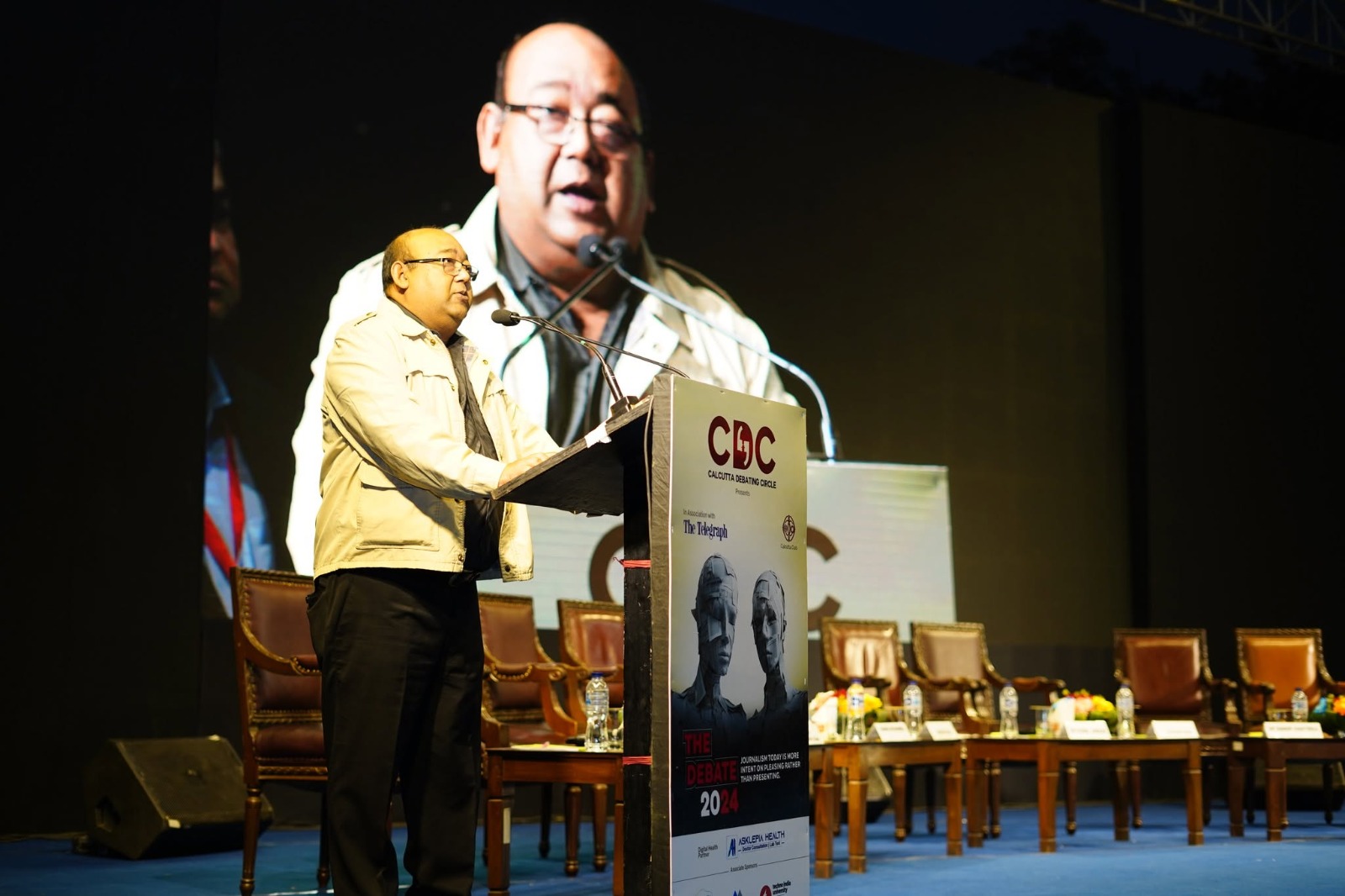
The Debate — flagship public forum
Held in partnership with The Telegraph, where the audience itself is the jury. The most recent edition, “Hinduism Needs Protection From Hindutva,” filled The Lawns at Calcutta Club with MPs, senior advocates, journalists, and academics arguing one motion to a live audience vote.
Mahua Moitra
Mani Shankar Aiyar
Swapan Dasgupta
J. Sai Deepak
Sudhanshu Trivedi
Agnimitra Paul
Covered by
- The Telegraph (since Dec 2013)
- Prabhat Khabar
- Salam Duniya
Year-round community
Beyond the headline events
CDC Prime
Students who debate year-round — not just once a season — building argument skills through regular practice and competition.
CDC Ambassador
Working professionals who keep the debating muscle alive — engaging with motions, rebuttals, and public argument beyond the workplace.
Where we're going
One motion, one room, one vote at a time
The gap we set out to close has not narrowed — if anything, today’s algorithm-driven media diet has made it wider.
CDC is reaching further: more schools and colleges across the eastern region, a larger and more engaged community of debaters, and national voices in front of local audiences — where every time, the room decides who won the argument.